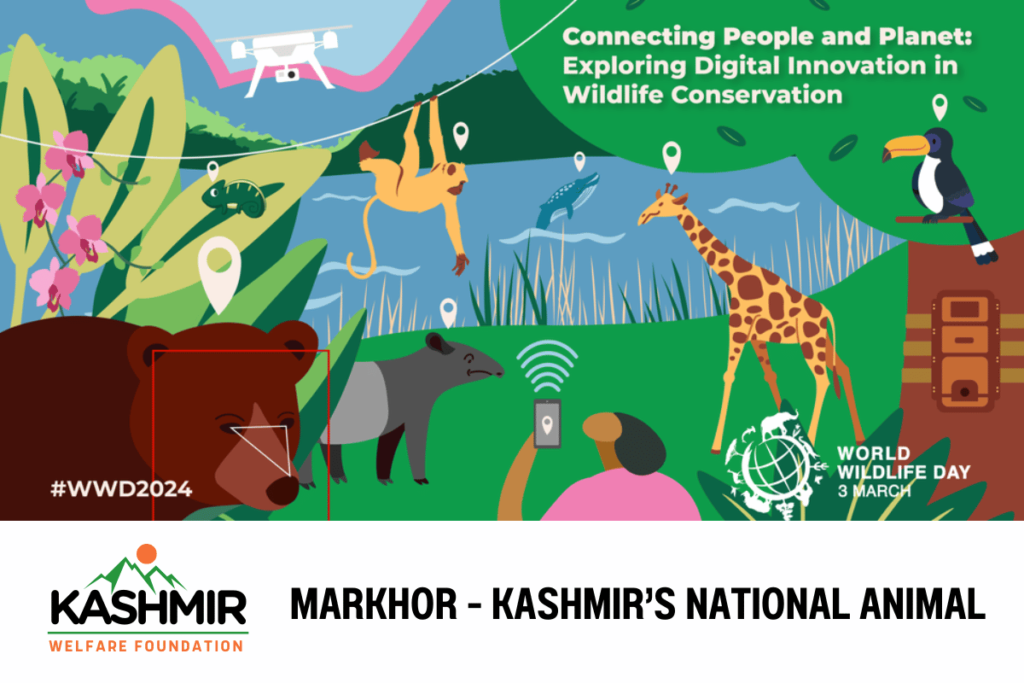
Every year on 3rd March, the world comes together to celebrate United Nations World Wildlife Day — a moment to honour the incredible diversity of wild animals and plants that share our planet. It is a reminder that every living being, from the smallest insect to the majestic mountain goat, plays a role in maintaining the balance of life on Earth.
The theme, “Connecting People and Planet: Exploring Digital Innovation in Wildlife Conservation,” highlights how technology can be used to safeguard our natural world. Yet, beyond technology lies a deeper spiritual call — one that reminds us of our duty as caretakers of creation. The Qur’an beautifully teaches:
“It is He who has made you successors upon the earth.” (Qur’an 35:39)
This verse calls humanity to act as khalifah (stewards) of the Earth, responsible for preserving its balance and beauty. On this World Wildlife Day, the Kashmir Welfare Foundation proudly celebrates the emblem of that responsibility — the Kashmir Markhor, Azad Kashmir’s national animal, a symbol of strength, grace, and divine creation.
💷 Gift Aid adds 25% extra at no cost to you.
The Markhor of Kashmir: Symbol of Strength, Survival, and Sacred Beauty
The Kashmir Markhor (Capra falconeri cashmiriensis), also known as the Flare-Horned Markhor, is one of nature’s most spectacular mountain dwellers. With its spiralling horns, thick winter coat, and agile frame, the Markhor navigates the steep cliffs and rocky terrains of the western Himalayas with ease. Found in parts of Pakistan, Afghanistan, Tajikistan, and the breathtaking valleys of Azad Kashmir, the Markhor is more than a national symbol — it represents the spirit of resilience woven into the heart of Kashmir’s people.
Once hunted almost to extinction, the Markhor has made a slow and hopeful recovery through focused conservation efforts. It remains listed as “Near Threatened” on the IUCN Red List, with an estimated 5,000 to 6,000 individuals remaining across its range. In Azad Kashmir, they roam the rugged slopes of Neelum Valley, Leepa Valley, and the high-altitude forests near Shounter and Kel, where community conservation projects have helped protect their fragile habitats.
The Qur’an reminds us that every creature glorifies the Creator in its own way:
“Do you not see that Allah is exalted by whomever is within the heavens and the earth and by the birds with wings spread? Each of them knows its means of prayer and exalting Him.” (Qur’an 24:41)
To preserve the Markhor is therefore to protect a sign of Allah’s creative power — a living reminder of our responsibility to guard the wonders He placed under our care.
Wildlife Conservation in Azad Kashmir: Protecting Nature’s Balance
Azad Kashmir’s landscape is one of the most ecologically diverse regions in South Asia. From alpine meadows and pine-covered mountains to crystal-clear rivers and forested valleys, it sustains countless species of plants and animals. Yet this ecological harmony — or mīzān, as the Qur’an describes it — is increasingly under threat.
“And the heaven He raised and imposed the balance, that you do not transgress within the balance.” (Qur’an 55:7-8)
Recent data from the Azad Jammu and Kashmir Forest Department shows that only about 36% of the region remains under forest cover, much of it degraded by logging, urban expansion, and soil erosion. Species such as the Himalayan black bear, musk deer, and snow leopard are struggling to survive as their habitats shrink. The Markhor, being both a grazer and prey species, is a keystone animal — its survival ensures the stability of the entire mountain ecosystem.
Kashmir Welfare Foundation’s conservation initiatives in Kashmir aim to protect this natural balance, focusing not only on wildlife but also on the people who share their land with these creatures. By linking livelihood opportunities with conservation, the Foundation helps local communities see the protection of nature as a source of dignity, faith, and income — not a burden.
The Hidden Crisis: Deforestation, Climate Change, and Poaching in Kashmir
Behind Kashmir’s breathtaking beauty lies an environmental crisis. Illegal logging and uncontrolled grazing have led to soil degradation and habitat loss, while climate change is reshaping entire ecosystems. In some valleys, early snowmelt now floods villages that were once dry, and rising temperatures are altering the migration and breeding patterns of wildlife.
Equally damaging is poaching — often driven by poverty or demand for Markhor horns, which are valued by collectors. Trophy hunting, even when legalised elsewhere, risks undermining local conservation ethics. Each act of exploitation echoes the Qur’anic warning:
“Do not cause corruption upon the earth after its reformation.” (Qur’an 7:56)
Environmental destruction is not only an ecological tragedy but a moral failing — a form of fasād fil-arḍ (corruption on Earth). The Kashmir Welfare Foundation works to confront this crisis through awareness campaigns, ranger support, and community-led reforestation projects, ensuring that no family must choose between feeding their children and protecting the land they live on.
In 2023 alone, Kashmir Welfare Foundation supported the planting of over 15,000 native trees across degraded slopes in Neelum and Muzaffarabad. These trees now act as windbreaks, prevent erosion, and restore food sources for herbivores like the Markhor.
Digital Innovation in Conservation: Technology Saving Wildlife in Kashmir
This year’s World Wildlife Day theme reminds us that innovation can amplify our impact. In the remote valleys of Azad Kashmir, digital tools are transforming how conservation is carried out. Kashmir Welfare Foundation has begun exploring technologies like drone-based forest mapping, AI-powered camera traps, and GPS tagging to track wildlife movements and identify illegal logging sites.
In villages near Leepa Valley, young volunteers are using mobile apps to record wildlife sightings — a simple yet powerful act of citizen science. This data helps identify key migration corridors and potential conflict zones between humans and animals.
Technology, however, is only as effective as the people who use it. That’s why Kashmir Welfare Foundation combines innovation with ilm (knowledge) and hikmah (wisdom), rooted in Islamic ethics. Digital transformation, when guided by compassion and purpose, becomes an act of stewardship — protecting creation with the very intelligence Allah bestowed upon humankind.
The Kashmir Welfare Foundation’s environmental mission stands on three core pillars that unite nature conservation with human development.
Kashmir Welfare Foundation leads extensive habitat restoration across mountain slopes and watersheds, planting native trees like Deodar and Chir Pine. Each reforestation drive restores soil fertility, prevents flooding, and provides new grazing grounds for the Markhor and other wildlife. Every tree planted is a Sadaqah Jariyah — a continuous charity that benefits generations to come.
Education is at the heart of Kashmir Welfare Foundation approach. Through workshops in rural schools, imam engagement, and women’s groups, the Foundation helps communities understand that caring for nature is part of faith. Children learn that when they protect a bird’s nest or plant a sapling, they are fulfilling the Prophet Muhammad’s (peace be upon him) guidance:
Kashmir Welfare Foundation eco-tourism programmes link visitors with conservation efforts, ensuring tourism income supports wildlife protection. Local families are trained as eco-guides, and portions of tourism proceeds fund reforestation and waste management projects. This approach allows donors to see how each contribution directly empowers both people and planet.
These projects are not just environmental interventions — they are social transformations. A former hunter in Neelum Valley now works as a Kashmir Welfare Foundation ranger, using his mountain knowledge to protect the very animals he once pursued.
Your support is the lifeline of conservation in Azad Kashmir. Every contribution strengthens Kashmir Welfare Foundation mission to safeguard wildlife, restore habitats, and empower local communities.
Each donation is not merely financial support — it’s an act of worship, a form of Amanah (trust) between humanity and creation. By giving to protect the Markhor and its habitat, you are honouring that trust and continuing a legacy of mercy.