
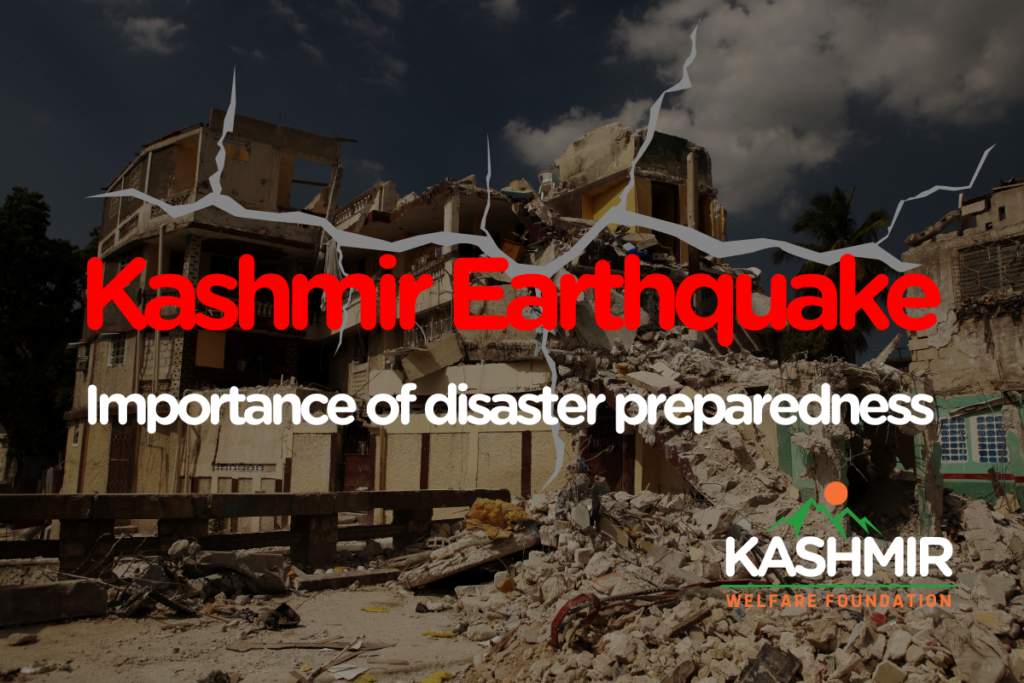
On 8 October 2005, Kashmir experienced one of the deadliest earthquakes in modern history. Within minutes, nearly 100,000 lives were lost. Homes, schools, and hospitals were reduced to rubble. Millions were left homeless in the harsh mountain cold.
It was not just the earthquake that killed. It was also the lack of preparedness, planning, and response systems. Families were trapped for days under collapsed buildings, children lost parents and teachers, and remote villages waited weeks for aid.
Twenty years on, the lessons from 2005 are more urgent than ever. Earthquakes cannot be prevented. But we can prevent them from becoming mass tragedies again.
Families are waiting for help in times of Crisis. Help us prepare in advance.
SUPPORT EARTHQUAKE VICTIMS💷 Gift Aid adds 25% extra at no cost to you.
✅ Secure Donation • 100% Donation Policy • UK Registered Charity No. 1206824
The Science Behind Earthquakes: Why Kashmir Is at Risk
Earthquakes happen when the earth’s crust releases pent-up energy in sudden jolts, sending seismic waves through the ground.
- Tectonic Plate Movements: Kashmir lies where the Indian Plate collides with the Eurasian Plate. The same forces that raise the Himalayas also create massive stress underground.
- Fault Lines in Kashmir:
- Main Boundary Thrust (MBT) – caused the 2005 disaster.
- Main Central Thrust (MCT) – another major seismic fault.
- Jhelum Fault – ran through Muzaffarabad, devastating whole towns.
- Indus-Kohistan Zone – deep activity that could fuel future quakes.
This is why scientists say: another major quake in Kashmir is not a matter of if, but when.
Can We Predict Earthquakes?
The hard truth is: No.
Technology has advanced. GPS tracking, seismic monitors, and P-wave detection systems can give seconds of warning. Japan, Mexico, and California already use these systems. But they cannot forecast where or when a quake will strike.
This makes preparedness the only defence. Even 20 seconds of warning can give time to hide under a table, switch off gas lines, or evacuate dangerous buildings.
Why Preparedness Matters: Lessons From 2005
The tragedy of 2005 was not just the tremor itself. It was the aftermath:
- Families trapped with no rescue equipment.
- Lack of clean water and medicine, spreading disease.
- No emergency shelters, forcing survivors into freezing nights.
- Schools collapsing on children because they were not built to resist quakes.
Widows and orphans carried the heaviest burden. Children who lost parents had no one to feed or shelter them. Mothers who lost husbands had no income, no home, and no future security.
This is where preparedness makes the difference. With simple measures—emergency kits, stronger buildings, community training—thousands of lives could have been saved.
Preparedness at Every Level
For Families
- Identify safe spots inside the home (sturdy tables, inner walls).
- Teach children “Drop, Cover, Hold On.”
- Secure heavy cupboards, TVs, and shelves to walls.
- Keep an emergency bag ready.
For Schools
- Regular earthquake drills with students and teachers.
- Build earthquake-resistant classrooms.
- Clear evacuation routes and assembly points.
For Workplaces & Communities
- Train staff in first aid.
- Have emergency response teams ready.
- Keep exits clear and equipment accessible.
What to Put in an Emergency Kit
A prepared family is a surviving family. An emergency kit can sustain people until aid arrives.
🛑 Essentials:
- Drinking water (minimum 3 days’ supply)
- Non-perishable food (biscuits, dry fruit)
- First aid kit with bandages, antiseptics, painkillers
- Torch and spare batteries
- Warm clothing and blankets
- Copies of important documents (ID cards, property papers)
- Cash and mobile power bank
In the 2011 Japan earthquake, families with kits survived days before rescue. In Kashmir, where mountain roads often block, a kit can mean the difference between life and death.
The Role of Kashmir Welfare Foundation
When disaster strikes, speed saves lives. Kashmir Welfare Foundation is committed to ensuring Kashmir never suffers another 2005 without preparation.
Our work includes:
🚑 Emergency Medical Aid – Doctors, medicines, and first aid kits delivered to affected zones.
🏠 Temporary Shelter – Tents, blankets, and safe spaces for displaced families.
🍲 Food and Water Relief – Hot meals, clean water, and survival packs.
🔧 Rebuilding – Supporting earthquake-resistant homes and schools.
Emergency & Disaster Response Fund
To save lives in the next earthquake, we must act now. That’s why we have built the Emergency & Disaster Response Fund.
Your support helps us:
✔ Pre-position medical and food supplies.
✔ Train youth volunteers in first aid.
✔ Stockpile survival kits.
✔ Fund rapid shelter and water projects.
👉 Donate your Zakat or Sadaqah today to protect Kashmir’s future. Give to the Emergency Fund
Even £10 can provide life-saving aid for a survivor.
Final Thoughts: Preparing for Tomorrow
The 2005 earthquake was a warning. Nearly 100,000 died because we were unprepared. Today, we do not have that excuse.
We cannot stop the next earthquake. But we can stop it from killing thousands of innocent families.
💡 What you can do today:
✅ Talk to your family about earthquake safety.
✅ Build an emergency kit.
✅ Support the Kashmir Welfare Foundation Emergency Fund.
Disasters don’t wait. Neither should we.
👉 Be part of the solution. Donate now. Support Kashmir’s Preparedness
Kashmir Earthquake FAQs
1. Why was the 2005 Kashmir earthquake so deadly?
Because there was no preparedness. Weak buildings, lack of emergency services, and no public awareness turned it into one of the deadliest earthquakes in modern history.
2. Is Kashmir still at risk of another major earthquake?
Yes. Kashmir lies on one of the world’s most active seismic belts. Experts believe another devastating quake is inevitable.
3. How can Zakat and Sadaqah help earthquake victims?
Donations fund medical supplies, food packs, shelters, and rebuilding. Giving your Zakat or Sadaqah to Kashmir Welfare Foundation ensures immediate relief for families in need.
4. What is the Emergency & Disaster Response Fund?
It’s a pre-planned fund that allows us to act the moment disaster strikes, without waiting for fundraising. This saves lives in the crucial first hours after an earthquake.
5. What lessons were learned from 2005?
That preparedness saves lives. Communities must be educated, trained, and equipped to respond quickly when the ground shakes.
Nearly 100,000 died in the 2005 Kashmir earthquake. Learn its lessons and support Kashmir Welfare Foundation’s Emergency Relief Fund today.
