
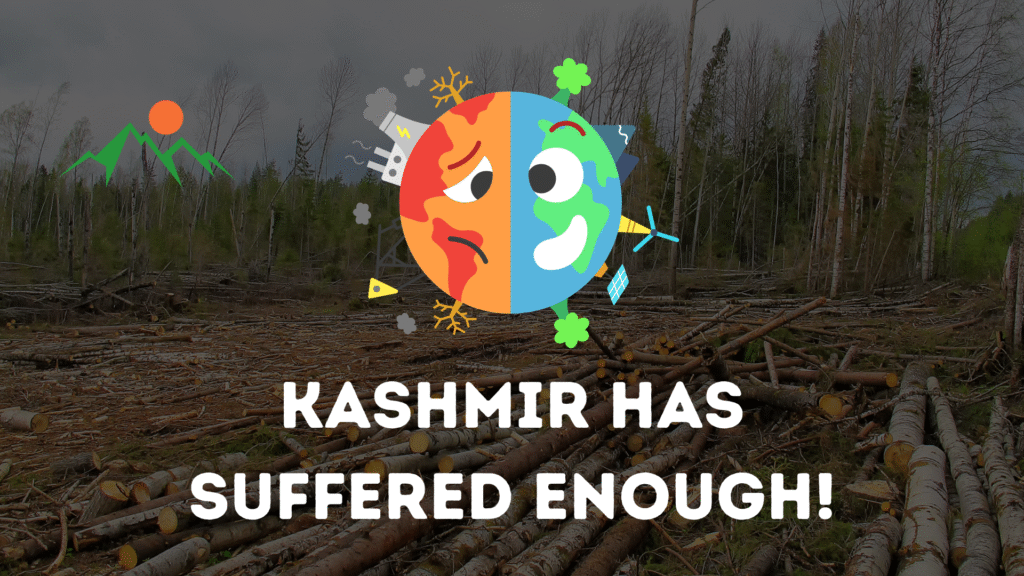
There are poems that do more than rhyme words — they pierce the heart. The verses shared here echo with a grief that is both personal and universal. Written by Khawaja Mohammad Afaq from Neelum Valley, this is a cry from the mountains of Kashmir, a lament for our forgotten relationship with nature.
The trees you cut down, Were older than your father. The earth was shifting all around, Yet the trees stood firm, holding the ground. Not a single tree was spared, While countless people perished. When the days of our meeting finally came, It was a season of loyalty — and earthquakes. The sun that now scorches them, I’ve heard — they once cut down the trees. | یہ جن درختوں کو تو نے کاٹا وہ تیرے بابا سے بھی بڑے تھے زمین ساری سرک رہی تھی درخت جکڑے ہوٸے کھڑے تھے بچا نہ افسوس اک شجر بھی سو لوگ کثرت سے مر رہے تھے ہمارے ملنے کے دن جو آٸے وبا کا موسم تھا ، زلزلے تھے یہ دُھوپ جن کو جلا رہی ہے سُنا ہے پیڑوں کو کاٹتے تھے |
Written by Khawaja Mohammad Afaq (Neelum Valley)
The Trees That Held Us
At first glance, these lines may seem like a simple lament for lost trees. But dig deeper and you’ll find an elegy for all of us — for our careless destruction of what sustained us, and for the spiritual disconnection that has left us fragile in the face of nature’s fury.
When Afaq writes that the trees “were older than your father,” he reminds us that trees are living testaments of time. They have stood through generations, through wars and weddings, through prayers and storms. They are silent witnesses to history, guardians of air, soil, and water.
The people of Kashmir have long understood this bond. Trees shield homes from landslides, hold the earth together, and give fruit, shade, and life. In their stillness, they carry patience — a quality humanity is losing as it cuts faster than it plants.
When the Ground Trembles and the Sky Burns
“The earth was shifting all around, yet the trees stood firm, holding the ground.”
It’s a poetic image — but also scientific truth. Roots prevent erosion, absorb water, and keep mountains steady.
When deforestation spreads across Azad Kashmir’s hills, every tree felled takes a piece of stability with it. The floods that wash through Bagh and Neelum, the landslides that bury homes in Muzaffarabad, and the soil that turns to dust in Kotli — these are not coincidences. They are consequences.
Kashmir is facing its own climate crisis. Forests that once covered 40% of the land have fallen to less than half that number. Global warming brings sudden cloudbursts, flash floods, and droughts, while our hills grow bare. What was once paradise now trembles under heat and neglect.
When Afaq writes of “a season of loyalty — and earthquakes,” it feels like the ground is shaking right now. The earth itself is protesting. Every quake, every storm, every flood whispers the same question: When will you stop cutting down what protects you?
The Brutality of Forgetfulness
“Not a single tree was spared, while countless people perished.”
This couplet cuts to the soul. It ties human suffering directly to human action.
We destroy forests, and in return, floods drown us. We burn fields, and the air turns against us. We fill rivers with waste, and then cry when the water runs dry.
Our forgetfulness is not just ecological — it is moral. We have forgotten amanah — the sacred trust given to us as caretakers of the earth. The Qur’an calls humanity khalifah — stewards of creation. But instead of guardians, we have become consumers.
We take endlessly, and rarely give back. Yet even as we pollute, Allah’s mercy endures. Rain still falls. Trees still sprout. But for how long if our gratitude remains absent?
Faith, Earth, and Responsibility
In Islam, the environment is not separate from faith. The Prophet Muhammad ﷺ said, “If the Day of Judgment comes and you have a sapling in your hand, plant it.”
This powerful teaching makes tree planting not only a good deed but an act of worship. A tree gives life for generations — fruit for humans, shade for animals, oxygen for the earth. It continues to benefit others long after we are gone, making it a true Sadaqah Jariya — ongoing charity.
Every tree planted in Kashmir is a dua in the soil. It stands as a witness of faith, a promise to future generations that we cared enough to act.
Through the Green Kashmir Project, Kashmir Welfare Foundation is working to restore these lost forests. From the valleys of Bagh to the slopes of Neelum, our teams are replanting native trees, building community awareness, and protecting existing forest zones. Each sapling represents hope — a living shield against floods and droughts.
Diaspora Duty: Healing the Land of Our Roots
For British Pakistanis and Kashmiris, the pain of watching climate disasters unfold back home hits deeply. Many of us grew up hearing stories of our parents’ villages — of fruit trees by rivers, of cool breezes from pine forests. But today, those same areas face soil erosion, barren hills, and rising temperatures.
This is not just about nostalgia. It’s about identity. To protect Kashmir’s forests is to honour our heritage.
When you give through Kashmir Welfare Foundation’s Green Kashmir Project, your Sadaqah Jariya becomes a living part of that landscape. Each donation helps plant trees that stabilise soil, reduce floods, and sustain life.
It is a way to reconnect — to give back to the land that gave your family its first breath.
Returning to the Roots
The poet’s verses remind us that the earth’s patience has limits. The “sun that now scorches them” is not punishment — it is reflection. What we do to the earth returns to us.
Global warming is not only a scientific crisis; it is a spiritual one. The world’s imbalance reflects our inner imbalance.
If we return to loyalty — to gratitude, compassion, and care for creation — then perhaps the earthquakes will quiet, the storms will ease, and the forests will breathe again.
The trees that once shielded us, the rivers that once fed us, the winds that once cooled us — all are asking: Will you stand with us, or fall with us?
Now is the time to plant.
To give life.
To rebuild what we broke.
🌱 Help us plant trees in Kashmir today. Be part of the Green Kashmir Project.
Tree Plantation Projects FAQs
1. Why is tree planting so important for Azad Kashmir?
Azad Kashmir’s steep terrain is prone to landslides and floods. Trees prevent erosion, stabilise the soil, and restore rainfall patterns. Every tree planted reduces climate risk for thousands of families.
2. How does donating to tree planting count as Sadaqah Jariya?
A tree that provides fruit, shade, or oxygen benefits life long after you’re gone. Islam teaches that any ongoing benefit counts as continuous charity — Sadaqah Jariya — and tree planting is one of the purest forms.
3. What is the Green Kashmir Project?
The Green Kashmir Project by Kashmir Welfare Foundation focuses on reforestation, soil conservation, and community-led environmental education across Azad Kashmir. It’s part of the wider Green Kashmir Campaign, which aims to plant over one million trees and protect natural ecosystems.
4. Can I donate on behalf of someone else?
Yes. You can dedicate your donation in the name of a loved one. It’s a beautiful way to give ongoing charity in memory of someone, ensuring their reward continues for every leaf that grows.
5. How much does it cost to plant a tree in Kashmir?
Every £12 donation helps plant and maintain multiple saplings, supporting community forestry projects. Even a small contribution can transform landscapes and lives.
