A Cry in the Mountains: A Mother’s Plea for Help
In the rugged hills of Neelum Valley, where steep tracks replace roads and silence dominates the valleys, a young mother named Shazia held her feverish child close. For three days, her two-year-old son, Bilal, had been burning with fever, his cries echoing through their wooden home in the remote hamlet of Tao Batt. The nearest hospital was a two hour journey away, over landslide-prone tracks and icy rivers. With no vehicle, no money, and no doctor in sight, Shazia feared the worst.
But then, word spread through the village — “Doctors are coming.”
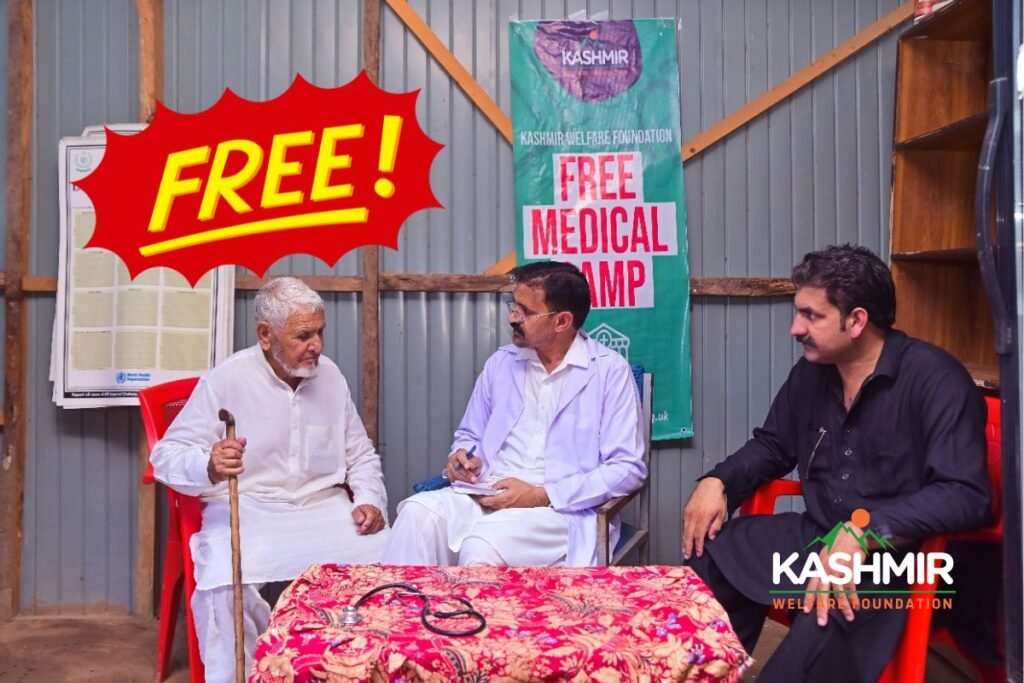
That morning, the Kashmir Welfare Foundation Free Medical Camp arrived. A team of volunteer doctors, nurses, and paramedics had trekked deep into the valley carrying medical supplies, diagnostic kits, and essential medicines. For Shazia, and hundreds like her, this was more than just healthcare — it was hope arriving at their doorstep.
Within hours, Bilal was diagnosed with pneumonia, given antibiotics, and placed under observation. Two days later, his fever subsided. Shazia wept as she held her child, whispering, “Allah sent you to save him.”
The Harsh Reality of Healthcare Access in Azad Kashmir
Azad Jammu and Kashmir (AJ&K) is a land of breathtaking beauty — from the snow-clad peaks of Neelum to the emerald waters of Leepa Valley. Yet beneath this beauty lies a stark truth: healthcare remains beyond reach for many.
According to the AJ&K Bureau of Statistics (2024), the region’s population stands at 4.46 million, but there are only 1,148 doctors — roughly one doctor for every 3,886 people. The health infrastructure is limited to:
- 8 teaching and other hospitals
- 7 District Headquarters (DHQ) hospitals
- 14 Tehsil Headquarters (THQ) hospitals
- 46 Rural Health Centres (RHCs)
- 233 Basic Health Units (BHUs)
- 78 dispensaries
That’s just one hospital bed for every 1,512 residents.
In villages tucked into mountain valleys, these numbers are even more alarming. Roads are often blocked by snow or landslides, leaving families without access to basic treatment for weeks. Pregnant women travel miles on foot, elderly patients suffer in silence, and children like Bilal face preventable deaths.
Diseases such as respiratory infections (546,000+ cases annually), diarrhoea, malaria, and hypertension remain common. The infant mortality rate stands at 47–51 per 1,000 live births, and the maternal mortality ratio at 104 per 100,000 live births.
These figures paint a picture of a region in desperate need of accessible, compassionate, and mobile healthcare solutions.
Why Free Medical Camps Matter
Free medical camps are not a luxury in Azad Kashmir; they are a lifeline. Organised by Kashmir Welfare Foundation, these camps travel into the remotest areas — often where government healthcare facilities are non-existent or too distant to reach.
Each camp provides:
- Free medical consultations by qualified doctors and nurses
- Diagnostic tests for blood sugar, cholesterol, and blood pressure
- Essential medicines distributed at no cost
- Mental health counselling sessions
- Women’s health clinics for maternal and postnatal care
These camps directly serve communities that live hours or even days from the nearest clinic. For many, it’s their first medical check-up in years.
As Dr. Shah Nawaz, a volunteer physician from Muzaffarabad, explains:
“In Neelum, one in every five patients we see has never spoken to a doctor before. The gratitude in their eyes makes every journey worth it.”
Building Health Awareness and Trust
Beyond treatment, these camps build something deeper — health awareness and trust.
In many rural areas, cultural barriers prevent people from seeking medical help. Women, in particular, often suffer quietly from conditions such as anaemia, hypertension, and reproductive health issues. During Kashmir Welfare Foundation’s Free Medical Camps, female doctors and counsellors play a crucial role in breaking this silence, offering private consultations and vital education about maternal and child health.
Moreover, every camp focuses on preventative care — teaching families about hygiene, nutrition, and early detection of diseases. These sessions have proven instrumental in reducing recurring illnesses, especially among children.
The Numbers Behind the Need
Let’s look at the reality on the ground:
- 82.5% of AJK’s population lives in rural areas.
- Only 46 Rural Health Centres and 233 BHUs serve the entire state.
- The government allocates just 6.82% of its 2024–25 development budget to health — Rs 3 billion across all sectors.
For a population nearing 4.5 million, this funding barely scratches the surface.
According to health department data, there were over 5.5 million outpatient visits (OPD) in 2023, with acute respiratory infections being the most common cause. Yet, in mountain areas like Haveli and Leepa, where health posts are sparse, many cases go unreported.
This is where Kashmir Welfare Foundation steps in — filling the healthcare void left by infrastructure limitations.
Changing Lives, One Camp at a Time
Impact Box — Free Medical Camps by Kashmir Welfare Foundation (2023–24):
- 12 major camps conducted across Neelum, Leepa, Bagh, and Haveli.
- Over 8,500 patients treated, including 1,200 children and 600 expectant mothers.
- 2,000 diagnostic tests carried out on-site.
- 5,000+ units of essential medicine distributed free of charge.
- Mental health counselling provided for 300 individuals, focusing on post-conflict trauma and anxiety.
Each statistic represents a story of survival — like that of Humaira, a 45-year-old from Bagh, who discovered her diabetes during one such camp. She recalls:
“For years, I thought my constant tiredness was part of life. The doctors at the camp tested my sugar, gave me medicine, and taught me how to eat better. I feel like I’ve been given a second chance.”
UK Donors: The Heart of This Mission
Behind every medical camp stands the generosity of UK donors who believe that compassion knows no borders.
For the Kashmiri diaspora, these initiatives are deeply personal. Many donors fund camps in the villages their parents or grandparents once called home. They give Zakat, Sadaqah, and Regular Donations not out of charity alone, but as a way of giving back — a bridge of care between the UK and Kashmir.
Every £20 donation can provide a patient with medical consultation, basic tests, and essential medication. Larger contributions fund entire camps that serve hundreds of families in a single day.
This growth requires continued donor support — not just for today’s emergencies, but for building a future where every Kashmiri can access healthcare with dignity.
Every contribution counts. When you donate, you are helping us deliver: